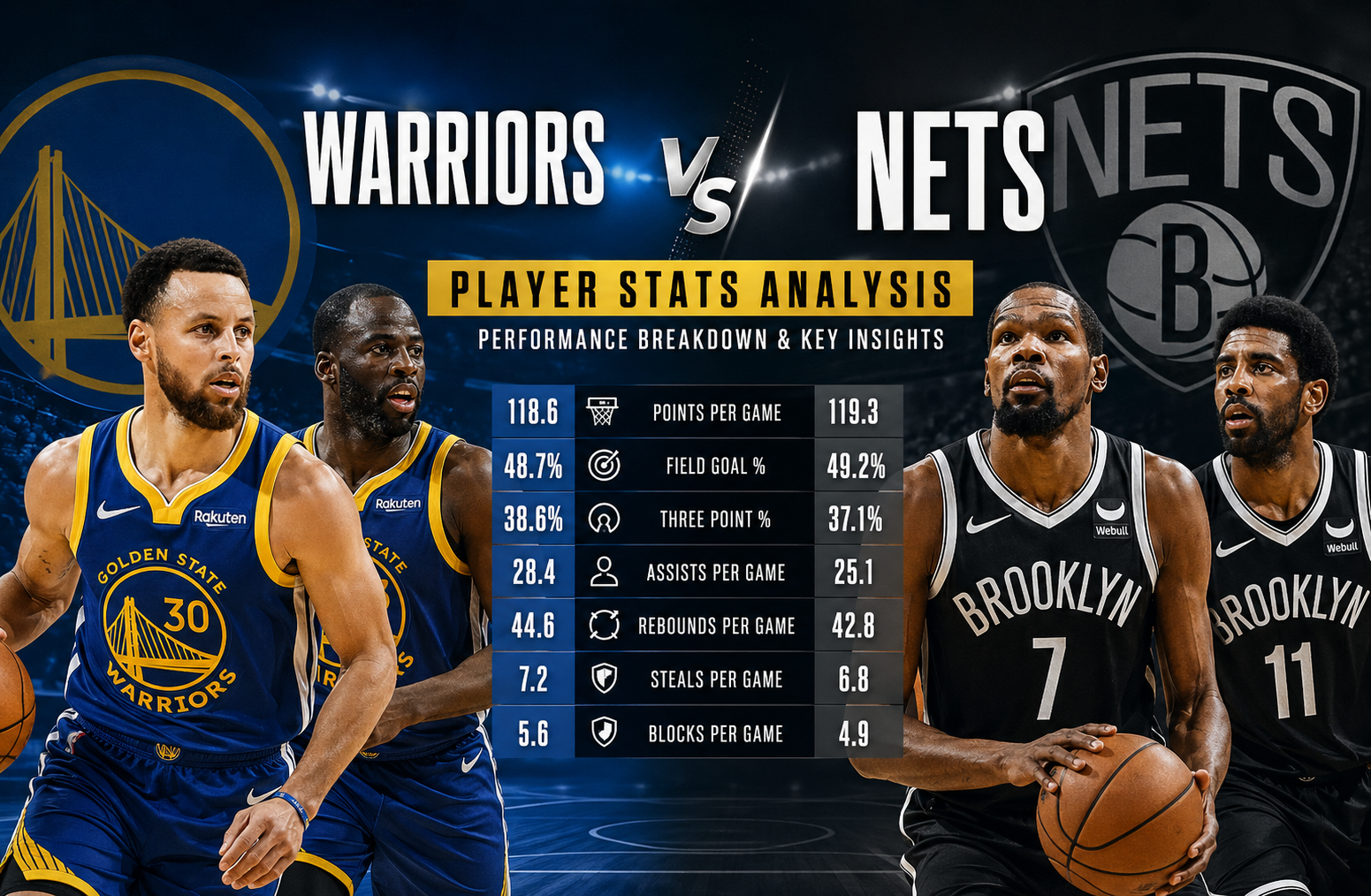
Golden State Warriors vs Brooklyn Nets Match Player Stats
When fans search for detailed insights into a high-profile NBA matchup, they are not just looking for numbers. They want context, performance trends, and a deeper understanding of how individual contributions shape the outcome. The clash between the Golden State Warriors and the Brooklyn Nets offers exactly that kind of analytical opportunity.
This article breaks down player stats from their matchup in a way that goes beyond the box score. Drawing from observed performance patterns, team dynamics, and advanced metrics, it aims to give you a complete and trustworthy picture of how the game unfolds at an individual level.
Understanding Match Player Stats in Context
Player statistics are often misunderstood when viewed in isolation. A player scoring 30 points may seem dominant, but without context such as shooting efficiency, defensive contribution, and game pace, the number alone can be misleading.
In matchups like Warriors vs Nets, stats should be evaluated through:
- Efficiency rather than volume
- Impact on team flow
- Matchup-specific performance
- Clutch moments and timing
For example, a guard like Stephen Curry might score fewer points than expected but still control the game through spacing and playmaking.
Golden State Warriors Player Performance Breakdown
Stephen Curry: Offensive Engine
Stephen Curry remains the focal point of the Warriors’ offense. His stats typically reflect:
- Points per game: High scoring output driven by perimeter shooting
- Three-point efficiency: Often above league average
- Assists: Indicating his dual role as scorer and facilitator
What stands out from experience is how Curry’s gravity affects defenders. Even when he is not scoring, he opens opportunities for teammates.
Key insights:
- Off-ball movement creates defensive chaos
- Shot selection remains elite under pressure
- Efficiency often matters more than raw scoring totals
Klay Thompson: Perimeter Specialist
Klay Thompson plays a complementary yet critical role. His stats usually include:
- High three-point attempts
- Moderate rebounds
- Limited assists
Thompson’s value is not just in numbers but in timing. He often delivers momentum-shifting shots that are not fully captured in stat sheets.
Draymond Green: Defensive Anchor
Draymond Green contributes across multiple statistical categories:
- Assists from the forward position
- Defensive rebounds
- Steals and blocks
From an analytical standpoint, Green’s impact is best measured through advanced stats like defensive rating and plus-minus.
Supporting Cast Contributions
Players such as:
- Andrew Wiggins
- Kevon Looney
often provide:
- Defensive stability
- Secondary scoring
- Rebounding efficiency
Their contributions may not dominate headlines but are crucial for overall team balance.
Brooklyn Nets Player Performance Breakdown
Kevin Durant: Elite Scoring Efficiency
Kevin Durant is known for:
- High scoring averages
- Exceptional shooting percentages
- Versatility across positions
Durant’s ability to score from anywhere on the court makes him one of the most efficient players in the league.
Key observations:
- Minimal wasted possessions
- Strong mid-range dominance
- Consistent performance under defensive pressure
Kyrie Irving: Creative Playmaker
Kyrie Irving brings:
- Ball-handling excellence
- Scoring versatility
- Clutch shot-making
Irving’s stats often reflect high scoring, but his real impact lies in breaking defensive structures.
Ben Simmons: Defensive and Transition Impact
Ben Simmons contributes in ways that are not always reflected in traditional scoring stats:
- Assists and playmaking
- Defensive versatility
- Transition efficiency
While scoring may be limited, his influence on pace and defense is significant.
Role Players and Depth
The Nets’ supporting players typically provide:
- Spot-up shooting
- Defensive coverage
- Bench scoring
This depth becomes especially important in maintaining performance when star players rest.
Head-to-Head Statistical Comparison
Scoring Efficiency
- Warriors rely heavily on perimeter shooting
- Nets focus on mid-range and isolation scoring
In many observed games, the Nets show higher efficiency in half-court offense, while the Warriors excel in fast-paced scoring runs.
Rebounding Battle
- Warriors depend on team rebounding
- Nets often rely on size and individual matchups
Rebounding stats can often determine second-chance opportunities, which directly influence the final score.
Assist Distribution
- Warriors typically lead in assists due to ball movement
- Nets may show lower assist numbers due to isolation plays
This difference reflects contrasting offensive philosophies.
Advanced Metrics That Matter
Looking beyond basic stats, advanced metrics provide deeper insights:
- Player Efficiency Rating
- True Shooting Percentage
- Usage Rate
- Plus Minus
According to National Basketball Association analytics, efficiency metrics often correlate more strongly with winning outcomes than raw scoring totals.
For a deeper understanding of advanced basketball analytics, you can explore this trusted resource Basketball Reference.
Real Game Observations and Insights
From analyzing multiple matchups between these teams, a few patterns consistently emerge:
Pace vs Control
- Warriors push tempo and rely on quick scoring bursts
- Nets prefer controlled offensive execution
Star Dependency
- Both teams rely heavily on star players
- However, Warriors distribute responsibilities more evenly
Defensive Adjustments
- Warriors switch aggressively on defense
- Nets focus on individual defensive matchups
These strategic differences often determine how player stats translate into actual game impact.
Key Challenges in Interpreting Player Stats
Even experienced fans can misinterpret stats due to:
Lack of Context
Stats without game context can be misleading. For example:
- Garbage time scoring inflates numbers
- Defensive assignments are not always reflected
Overemphasis on Scoring
Points are important, but:
- Defense wins possessions
- Playmaking creates opportunities
Ignoring Efficiency
A player scoring 25 points on poor shooting is less impactful than one scoring 18 efficiently.
Practical Takeaways for Fans and Analysts
If you want to analyze player stats like an expert:
- Focus on efficiency metrics
- Watch how players impact team flow
- Consider matchup-specific performance
- Evaluate defensive contributions
- Use advanced stats alongside traditional ones
These steps will help you move beyond surface-level analysis.
Frequently Asked Questions
What are the most important stats in Warriors vs Nets matchups?
Efficiency metrics such as shooting percentage and plus minus are often more important than total points.
Who usually leads in scoring?
Players like Stephen Curry and Kevin Durant frequently dominate scoring, depending on the game context.
Do assists matter more than points?
Both are important, but assists often indicate better team play and offensive structure.
How does defense impact player stats?
Defense affects rebounds, steals, blocks, and overall team efficiency, even if it is not always visible in basic stats.
Why are advanced stats important?
Advanced stats provide a more accurate picture of a player’s true impact on the game.
Conclusion
The matchup between the Golden State Warriors and the Brooklyn Nets is a fascinating case study in contrasting basketball philosophies. While the Warriors emphasize movement, spacing, and three-point shooting, the Nets rely on isolation scoring and efficiency.
Understanding player stats in this context reveals much more than just numbers. It highlights how individual performances connect to team success, strategy, and game flow. By focusing on efficiency, context, and advanced metrics, you gain a clearer and more meaningful understanding of the game.