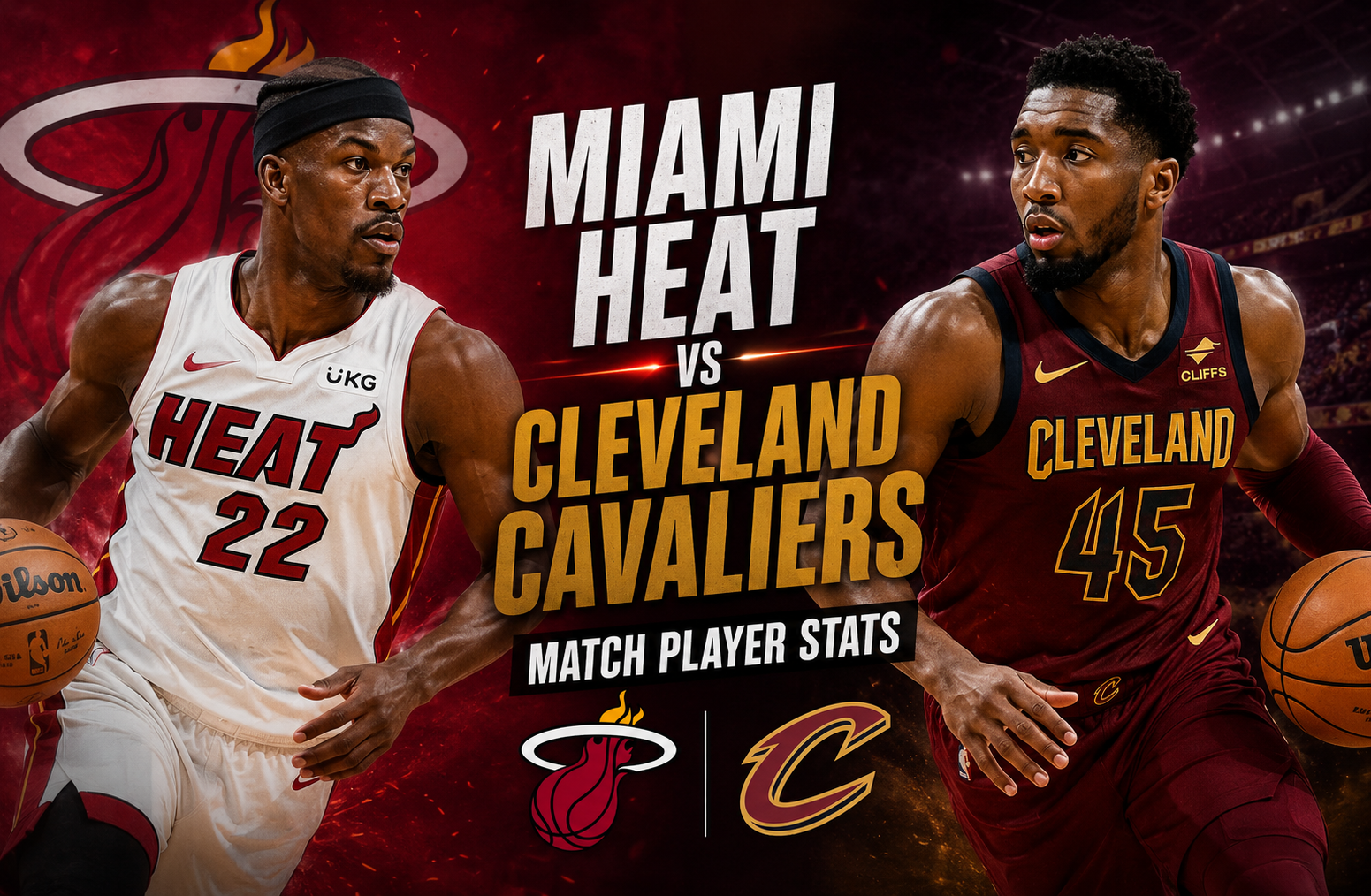
Miami Heat vs Cleveland Cavaliers Match Player Stats
The latest Miami Heat vs Cleveland Cavaliers Match Player Stats gave basketball fans a detailed look at how two competitive Eastern Conference teams approached one of the season’s most intense matchups. From defensive pressure and shot selection to bench production and late game execution, this contest revealed far more than the final score. It highlighted which players controlled momentum, which rotations worked under pressure, and how coaching adjustments shaped the game.
Fans searching for Miami Heat vs Cleveland Cavaliers Match Player Stats usually want more than a simple box score. They want context behind the numbers. They want to understand why one player dominated a quarter, how defensive switches disrupted offensive rhythm, and which moments changed the direction of the game. This article breaks down every important layer of the matchup in a people first, insight driven format that goes beyond surface level analysis.
The game showcased high level guard play, physical interior defense, and a playoff style intensity that made every possession meaningful. While statistics always tell part of the story, the real value comes from interpreting what those numbers actually mean in live basketball situations. That is where this analysis focuses.
Miami Heat vs Cleveland Cavaliers Match Player Stats Overview
The matchup between Miami and Cleveland reflected two different basketball identities. Miami relied heavily on disciplined defensive rotations, half court execution, and veteran composure. Cleveland focused on athletic scoring bursts, paint protection, and transition opportunities.
Several statistical categories defined the outcome:
- Field goal efficiency during the second half
- Three point conversion under defensive pressure
- Turnovers forced through aggressive perimeter defense
- Bench scoring consistency
- Rebounding during clutch possessions
- Free throw accuracy in the final minutes
The pace of the game shifted multiple times. Cleveland opened aggressively with fast transition attacks, while Miami slowed the tempo and forced more half court possessions as the game progressed.
One major takeaway from the contest was how efficiently star players created opportunities for teammates rather than forcing contested shots. The teams combined for excellent ball movement stretches that demonstrated modern NBA offensive philosophy.
First Quarter Breakdown
The opening quarter established the physical tone immediately. Cleveland attacked early through aggressive dribble penetration and interior scoring opportunities. Their guards consistently pressured Miami’s perimeter defenders, creating openings for cutters near the rim.
Miami responded with patient offensive sets and better spacing. Instead of rushing possessions, the Heat focused on creating favorable mismatches through switches and off ball movement.
Key first quarter observations included:
Cleveland’s Interior Presence
Cleveland established an early advantage by controlling points in the paint. Their big men altered multiple shots defensively while also finishing efficiently near the basket.
This interior pressure forced Miami to rely more heavily on mid range scoring and perimeter shooting during the opening stretch.
Miami’s Defensive Adjustments
Miami adjusted quickly after allowing easy transition baskets. Their defenders began collapsing into driving lanes earlier, forcing Cleveland into tougher perimeter attempts.
The Heat also increased communication during defensive switches, reducing open looks around the arc.
Tempo Control
One of the most important factors during the first quarter was tempo management. Cleveland wanted a faster game. Miami preferred a slower and more controlled rhythm. The battle over pace became a central storyline throughout the matchup.
Standout Miami Heat Player Performances
Jimmy Butler’s Leadership Impact
Jimmy Butler once again demonstrated why he remains one of the league’s most respected two way players. His statistical production was impressive, but the numbers alone did not fully capture his influence.
He controlled offensive possessions carefully, drew defensive attention, and consistently made the correct basketball decisions during critical stretches.
Important elements of Butler’s performance included:
- Efficient scoring without excessive shot volume
- Defensive pressure against primary ball handlers
- Smart late game playmaking
- Leadership during momentum swings
- Physical rebounding from the wing position
One noticeable aspect of Butler’s game was his patience. Instead of forcing difficult shots early in possessions, he waited for defensive breakdowns before attacking.
That approach helped Miami maintain offensive efficiency throughout several crucial sequences.
Bam Adebayo’s Defensive Versatility
Bam Adebayo delivered one of the most complete defensive performances of the game. His ability to guard multiple positions disrupted Cleveland’s offensive flow repeatedly.
Adebayo’s impact included:
- Rim protection during transition defense
- Switching onto guards effectively
- Contesting perimeter jumpers
- Strong rebounding positioning
- High efficiency finishing around the basket
His defensive communication also stood out. Several possessions showed him directing teammates into proper coverage while still protecting the paint.
That level of awareness is difficult to measure statistically but remains essential for elite team defense.
Tyler Herro’s Shot Creation
Tyler Herro provided offensive balance through perimeter shooting and secondary playmaking. He attacked gaps aggressively when defenders overcommitted and created important spacing opportunities for Miami’s frontcourt players.
Herro’s ability to score at multiple levels forced Cleveland to adjust defensive assignments throughout the game.
His strongest stretches came when Miami pushed the ball quickly after defensive rebounds. In those moments, Herro found rhythm before Cleveland’s defense could fully organize.
Cleveland Cavaliers Key Performers
Donovan Mitchell’s Offensive Explosion
Donovan Mitchell played with aggressive confidence from the opening minutes. His scoring bursts kept Cleveland competitive even during periods when the offense struggled collectively.
Mitchell excelled in several areas:
- Pull up shooting under pressure
- Transition scoring
- Isolation attacks against switches
- Creating space off the dribble
- Drawing defensive help defenders
What separated his performance from many high volume scorers was efficiency. He did not rely entirely on difficult contested shots. Instead, he manipulated defensive angles to create cleaner opportunities.
His second half scoring run became one of the defining stretches of the game.
Darius Garland’s Playmaking Control
Garland played a critical role as Cleveland’s offensive organizer. While his scoring numbers were solid, his greatest contribution came through ball distribution and tempo management.
He consistently identified weak side openings and delivered accurate passes under defensive pressure.
Garland also improved Cleveland’s spacing by forcing defenders to respect his perimeter shooting.
That combination opened driving lanes for teammates and reduced Miami’s ability to overload defensively.
Evan Mobley’s Defensive Presence
Mobley’s length and mobility significantly impacted Miami’s interior scoring attempts. His ability to recover defensively after switches prevented several easy baskets.
Beyond blocks and rebounds, Mobley influenced shot selection. Miami players frequently altered finishes or settled for difficult floaters when he rotated into the paint.
That type of defensive gravity changes offensive behavior even when it does not appear directly in traditional statistics.
Second Half Momentum Shifts
The second half featured multiple momentum changes that transformed the game into a tactical battle.
Miami opened the third quarter with improved ball movement and stronger perimeter defense. Their ability to limit transition opportunities slowed Cleveland’s offensive rhythm.
However, Cleveland responded with aggressive perimeter shooting and faster defensive rotations.
Key Momentum Swing
One of the most important stretches occurred midway through the third quarter when Cleveland forced consecutive turnovers and converted them into fast break points.
That sequence energized the crowd and temporarily shifted momentum.
Miami answered by slowing the pace again and attacking mismatches through controlled half court sets.
Clutch Time Execution
The final minutes highlighted the difference between regular scoring and clutch basketball execution.
Every possession carried increased pressure. Defensive intensity rose dramatically, and shot quality became more difficult to maintain.
Miami succeeded during several late possessions because of disciplined spacing and patient decision making.
Cleveland relied heavily on individual shot creation during crunch time, which produced mixed results.
Statistical Categories That Decided the Game
The final result was shaped by several statistical battles.
Three Point Efficiency
Three point shooting remains one of the most important factors in modern NBA basketball, and this matchup reinforced that reality.
The team that generated cleaner perimeter looks during late game possessions gained a major advantage.
Important shooting factors included:
- Corner three point efficiency
- Catch and shoot opportunities
- Shot quality after ball movement
- Transition three point attempts
- Defensive closeout speed
Miami’s disciplined offensive spacing created higher percentage perimeter looks during crucial stretches.
Turnovers and Transition Points
Turnovers directly influenced momentum throughout the game.
Cleveland generated several fast break opportunities by pressuring passing lanes aggressively. Miami responded by reducing risky cross court passes and emphasizing safer ball movement during the second half.
The ability to limit live ball turnovers became essential because transition defense was inconsistent for both teams at different moments.
Rebounding Battle
Rebounding numbers reflected the physical nature of the matchup.
Offensive rebounds extended important possessions and created second chance scoring opportunities.
Miami improved significantly on the defensive glass late in the game, preventing Cleveland from generating extra possessions during critical moments.
Coaching Strategies and Adjustments
One of the most fascinating aspects of the matchup involved coaching decisions.
Both staffs made notable tactical adjustments throughout the game.
Miami’s Rotational Discipline
Miami consistently trusted experienced lineups during pressure situations.
Their coaching staff emphasized:
- Defensive communication
- Controlled pace
- Reduced transition risks
- Efficient shot selection
- Physical perimeter defense
These adjustments helped stabilize the game during difficult stretches.
Cleveland’s Aggressive Pressure
Cleveland attempted to speed up the game whenever possible.
Their defensive strategy focused on:
- Forcing ball handlers toward help defenders
- Creating turnovers through active hands
- Pressuring passing lanes
- Increasing transition possessions
- Attacking early in the shot clock
This aggressive approach produced momentum swings but also created occasional defensive breakdowns.
Advanced Statistical Insights
Traditional box scores only reveal part of the story. Advanced metrics provide deeper context for player impact.
Offensive Rating Impact
Several players posted strong offensive efficiency numbers because they balanced scoring with smart decision making.
Rather than forcing low percentage shots, they created value through:
- Ball movement
- Efficient shot selection
- Transition awareness
- Extra passing
- Controlled tempo
Defensive Matchup Efficiency
One major storyline involved how effectively players defended specific matchups.
Miami’s switching system worked best when defenders communicated quickly and avoided mismatches near the rim.
Cleveland performed best defensively when their help rotations arrived early enough to disrupt Miami’s interior spacing.
Bench Productivity
Bench production often determines outcomes in close games.
Both teams received valuable contributions from reserve players, especially during second quarter stretches when starters rested.
Key bench impact areas included:
- Energy on defense
- Hustle rebounds
- Transition scoring
- Perimeter shooting
- Maintaining offensive rhythm
Miami’s bench provided steadier defensive energy, while Cleveland’s reserves produced stronger scoring bursts.
Real Basketball Lessons From the Matchup
This game offered several important basketball lessons that apply beyond professional competition.
Defensive Communication Matters
One of the clearest differences between successful and unsuccessful possessions involved communication.
Teams that rotated early and communicated switches effectively prevented open scoring opportunities.
Poor communication created defensive confusion and easy baskets.
Pace Control Changes Outcomes
Basketball is not only about talent. It is also about controlling rhythm.
Miami succeeded when the game slowed into structured half court possessions.
Cleveland performed better when the tempo increased and transition opportunities expanded.
Understanding preferred pace remains critical for team identity.
Shot Quality Over Shot Quantity
The game reinforced an important modern basketball principle.
Teams that generated higher quality shots consistently outperformed teams relying heavily on contested isolation attempts.
Good offense depends on spacing, patience, and decision making.
How Star Players Influenced Team Identity
Every elite NBA team develops a unique identity based on its best players.
This matchup highlighted that concept clearly.
Miami’s Identity
Miami’s approach reflected discipline, toughness, and defensive accountability.
Their star players emphasized:
- Smart possessions
- Defensive effort
- Physical play
- Controlled tempo
- Efficient scoring
That identity has defined Miami basketball for years.
Cleveland’s Identity
Cleveland relied more heavily on athleticism, offensive creativity, and transition pressure.
Their strengths included:
- Dynamic guard play
- Interior shot blocking
- Quick scoring runs
- Aggressive defensive pressure
- Fast pace opportunities
These contrasting styles created a compelling tactical matchup.
Miami Heat vs Cleveland Cavaliers Match Player Stats and Fan Reactions
Fans reacted strongly to several moments from the game.
Social media discussions focused heavily on:
- Clutch shot making
- Defensive intensity
- Officiating consistency
- Coaching decisions
- Momentum changing plays
Many analysts praised the playoff like atmosphere and physical competitiveness.
Observers also noted how both teams adjusted strategically throughout the contest rather than relying purely on talent.
That level of tactical adaptation often separates strong playoff teams from inconsistent regular season squads.
What This Matchup Means for the Season
Games like this often reveal long term trends that become important later in the season.
For Miami
The matchup confirmed that Miami remains one of the league’s most disciplined defensive teams when fully focused.
Their ability to slow pace and execute late game possessions remains a major strength.
However, consistent perimeter scoring still appears essential for maximizing offensive efficiency against elite defenses.
For Cleveland
Cleveland demonstrated significant offensive potential through athletic shot creation and transition scoring.
Their defensive ceiling also remains extremely high because of interior versatility.
The next step involves improving late game offensive organization against disciplined playoff caliber defenses.
Key Statistical Takeaways
The most important takeaways from the Miami Heat vs Cleveland Cavaliers Match Player Stats can be summarized clearly.
Miami Heat Key Numbers
- Strong defensive rebounding during clutch moments
- Efficient late game half court offense
- Balanced scoring across multiple players
- Improved second half perimeter defense
- Reduced turnovers under pressure
Cleveland Cavaliers Key Numbers
- Excellent transition scoring production
- Aggressive defensive pressure
- Strong interior protection
- Efficient guard scoring stretches
- High energy rebounding effort
These categories shaped the competitive balance throughout the game.
Comparing This Matchup to Previous Meetings
Compared to earlier meetings between these teams, this game showed noticeable tactical evolution.
Miami demonstrated better defensive discipline and stronger transition recovery.
Cleveland improved spacing and perimeter shot creation compared to previous matchups.
One major difference involved bench consistency. Earlier games often featured larger performance drops when starters rested. In this matchup, both benches maintained competitiveness more effectively.
Another noticeable change was shot selection.
Both teams appeared more patient offensively and less willing to settle for early contested attempts.
That adjustment reflected growing maturity and stronger tactical awareness.
The Importance of Match Player Stats in Modern Basketball Analysis
Modern basketball analysis depends heavily on context driven statistical interpretation.
Raw scoring totals alone no longer explain performance completely.
Today’s analysts evaluate:
- Shot efficiency
- Defensive matchup success
- Pace influence
- Spacing impact
- Turnover creation
- Transition effectiveness
- Clutch performance
- On court lineup combinations
That broader analytical approach helps fans understand why certain players influence games even without massive scoring numbers.
For example, a player may score modestly while still dominating defensively through positioning and communication.
Similarly, a guard with limited points may still control offensive tempo effectively through decision making.
This matchup provided excellent examples of those deeper basketball realities.
Areas Both Teams Must Improve
Even strong performances reveal weaknesses.
Miami Areas for Improvement
Miami still needs:
- More consistent three point shooting
- Faster transition recovery at times
- Greater offensive production from secondary scorers
- Reduced scoring droughts during physical stretches
Cleveland Areas for Improvement
Cleveland should continue improving:
- Half court execution under pressure
- Late game shot selection
- Turnover management
- Defensive discipline against veteran offenses
Addressing these issues could significantly influence future postseason success.
Frequently Asked Questions
What made this matchup so competitive?
The game remained competitive because both teams excelled defensively while also featuring multiple players capable of creating offense under pressure.
Which player had the biggest impact?
Several players influenced the game heavily, but the biggest impact came from those who contributed on both offense and defense rather than scoring alone.
Why are advanced stats important in basketball analysis?
Advanced statistics help explain efficiency, defensive impact, and possession value beyond traditional scoring totals.
Did bench players influence the result?
Yes. Bench production played an important role, especially during momentum shifts when starters rested.
What tactical adjustment changed the game most?
Miami’s improved second half defensive rotations and pace control significantly changed the flow of the matchup.
Why do fans search for detailed match player stats?
Fans want context behind the numbers. Detailed analysis explains how individual performances influenced team strategy and game momentum.
Conclusion
The Miami Heat vs Cleveland Cavaliers Match Player Stats revealed far more than individual scoring totals. The matchup highlighted defensive intelligence, tactical adjustments, efficient shot creation, and the importance of composure during pressure moments.
Miami showed why disciplined execution and defensive structure remain essential for winning close games. Cleveland demonstrated explosive offensive potential, athletic versatility, and an ability to create momentum quickly through aggressive play.
Most importantly, the game reminded basketball fans that statistics become truly meaningful only when connected to real game situations. Numbers alone cannot fully explain leadership, communication, defensive positioning, or momentum changing plays.
That deeper understanding is what transforms a simple box score into genuine basketball insight.